
English| EUR
Suggested for you
More currencies
Choose a language
Tortuguero has no road. Every arrival ends on water, which is why planning the trip from the capital is less about distance than about connections. This how to get to tortuguero from san jose guide explains the routes that exist, the timings that govern them, and the park rules that decide whether your first morning is worth the journey.
Quick answer
There is no road into Tortuguero: travelers cross the country by vehicle to a river landing, then continue by boat. Allow most of a day. The park itself runs 06:00–12:00 and 13:00–16:00 daily, with a non-resident conservation fee of 16.95 USD purchased in advance through SINAC. The 06:00–08:00 window offers the best wildlife viewing.
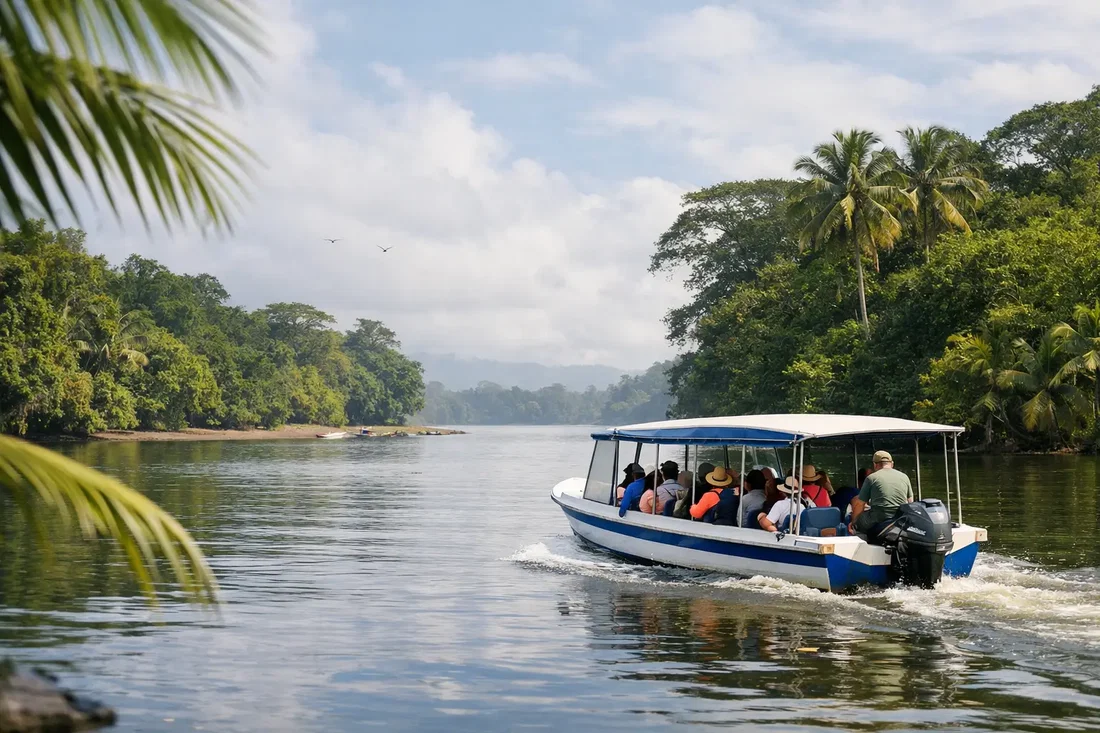
Tortuguero is one of the few national parks in Costa Rica that no highway reaches. The village and the park entrance sit on a narrow strip of land between the Caribbean Sea and a chain of freshwater canals, and the only ways in are by boat or by small aircraft. That single geographic fact governs everything about how to get to tortuguero from san jose, and it explains why the trip is measured in connections rather than kilometres. What the independent traveler is actually dealing with is a two-stage journey. The overland leg crosses the Central Valley and descends through the Braulio Carrillo corridor toward the Caribbean lowlands of Limón Province, where banana plantations replace cloud forest. The second leg is aquatic: a boat along the canals that were cut and linked in the 1970s to give the region a transport spine it never had by road. Because the two legs must meet, departure time from the capital is not a matter of preference. Boats run to a schedule shaped by daylight, and a late start in the Central Valley becomes a missed connection at the river landing. Travelers researching a Tortuguero transfer from San José, or comparing a guided Tortuguero canal tour against doing it alone, are really comparing how much of that scheduling risk they want to carry themselves. The park's own clock adds the second constraint. Tortuguero National Park operates in two blocks, closing at midday, and the recommended arrival window is 06:00–08:00, before heat pushes wildlife into cover. Green turtle nesting season on the beach, the reason many visitors come at all, is governed separately and requires a licensed guide. The conservation fee is bought in advance through SINAC rather than at a gate, so arrival is not the moment to sort paperwork. Read together, these facts point to one conclusion: a same-day round trip leaves almost no usable time inside the park. Most independent travelers who work out how to get to tortuguero from san jose end up building at least one night in the village into the plan, which converts a rushed transit day into a proper early morning on the canals. The dedicated sections below set out the route stages, the timings, and the pre-visit requirements in full detail.
“No highway reaches Tortuguero, so every arrival is a connection rather than a drive.”
Tortuguero National Park is located on the northern Caribbean coast of Costa Rica and is inaccessible by car, as there are no roads leading to the village. Travelers must reach the area by combining ground transportation with a boat journey or by taking a domestic flight.
San Jose (Gran Terminal del Caribe) to Cariari, then bus to La Pavona dock
Public boat or private launch from La Pavona dock to Tortuguero village
Domestic flight from San Jose (SJO) to Tortuguero airstrip
Visitors arriving via the La Pavona dock should plan to connect with the scheduled public boat services, which align with bus arrivals; parking is available at the La Pavona terminal for those driving to the water's edge.
This sequence takes you from central San Jose to the village of Tortuguero using public transport, combining a bus to the Caribbean lowlands with a river boat that covers the final stretch, since no road reaches the village. Allow five to six hours end to end, plus buffer time for connections.
Purchase the 16.95 USD non-resident adult conservation fee in advance through SINAC at https://www.sinac.go.cr, as it cannot be paid at the park entrance. Travellers routinely arrive at the ranger station without it and lose the morning waiting for a phone signal strong enough to complete the transaction.
Take a taxi or rideshare to Gran Terminal del Caribe in Barrio Tournon, north of downtown San Jose. Do not confuse it with Terminal Caribeos or the Atlantico Norte terminal, which serve different routes and are a common source of missed departures.
Ask at the counter for the service routed to Cariari and onward to La Pavona, rather than a bus terminating in Guapiles or Siquirres. Buy the ticket at the window, not from the driver, and keep the stub since it is checked again at the Cariari transfer.
Most services require a change at Cariari to a smaller bus for the final unpaved run to the La Pavona boat landing. Stay with your luggage during the switch and ignore anyone on the platform offering to 'reserve' your onward seat.
Buses are timed to meet the public boats that run down the Suerte and Tortuguero rivers, so walk straight to the dock rather than lingering at the soda. Boats depart when the connecting bus arrives, and the crossing takes roughly ninety minutes.
On arrival in Tortuguero village, check the posted boat times at the dock for your outbound day. Return departures are limited and fill quickly in high season, so settle this before you start exploring.
Plan your park entry for the 06:00-08:00 arrival window, which offers the best wildlife viewing conditions before the daily heat and midday closure. Bring the printed or downloaded SINAC receipt, since coverage at the ranger station is unreliable.
For confirmation on entry logistics, call the park directly on +506 2709-8086 before you travel. The address for navigation and onward planning is Tortuguero National Park, Limon Province, Costa Rica.
The best arrival window is 06:00–08:00, as early morning departures from San Jose align with peak wildlife activity before the midday heat. Arriving during this window ensures travelers access the park's canal systems while fauna remains active.
Humid, 24°C–30°C; peak nesting season.
Green sea turtles nest on beaches during these months. Visitors should plan for heavy rainfall throughout the season
Drier, 25°C–32°C; warm and sunny.
Lower rainfall provides clearer visibility on the canals. These months offer a balance between accessibility and weather conditions
—
Early weekday arrivals minimize congestion at park access points. This timing provides quieter conditions for observing wildlife along the waterways.
Verdict: For the best experience, plan travel for weekday mornings during the drier months of March through May or the peak turtle nesting months of July through October.
Tortuguero National Park maintains a consistent daily operating schedule throughout the week. Visitors should plan their arrival to align with these set hours.
Work through these preparations in order, starting weeks ahead and finishing the morning you set out for the canals.
Everything you need to know about how to get to tortuguero from san jose
To travel by public bus, take a direct service from the Gran Caribe terminal in San Jose to Cariari, then connect to a bus for La Pavona. From La Pavona, you must board a public water taxi to reach the village. This is the most cost-effective method to understand how to get to tortuguero from san jose.
No, there are no roads leading directly into the village. You must travel by land to a dock, such as La Pavona, and complete your trip by boat. This unique accessibility is why boat travel is a core part of your visit to the park.
The quickest way is by domestic flight from San Jose to the local airstrip, which takes approximately 30 minutes. This is a common choice for travelers seeking to maximize their time in the national park.
While some independent travelers manage arrivals upon reaching the dock, it is often recommended to verify departure times for the public boat. Boats typically coordinate with bus arrivals, but checking schedules ensures your logistics for how to get to tortuguero from san jose are sound.
You cannot drive directly into the park because the village is car-free. If you choose to rent a vehicle, you must leave it in a guarded parking lot at the La Pavona dock before boarding your boat.
Given the high rainfall in this region, it is essential to pack waterproof bags for your electronics and clothing. The open-air boats can be wet, so reliable rain gear and protective cases are highly recommended.
Yes, some shuttle companies may have specific limitations on luggage size or weight. It is best to confirm these details with your transport provider when researching how to get to tortuguero from san jose to avoid issues at pick-up.